As one verified example, Dyson lists its Supersonic Origin (Black/Nickel) at 1,600 W for 110–120 V, with four heat and three speed settings. This is the manufacturer’s specification, not a measured draw at every setting. See the Dyson product specifications. Check the label or manual for your exact model and market; this one product does not establish a universal range.
There is no single wattage for every hair dryer: the rating depends on the model, and a dryer may have several heat or speed settings. To find the number for yours, check its rating label or manual. That watt figure describes power—not the amount of electricity the dryer uses every time you turn it on. A dryer used for a few minutes uses less energy than the same dryer running for an hour.
The practical takeaway: wattage helps you estimate electrical demand and energy use, but it cannot tell you exactly how fast a dryer will dry your hair or how hot it will feel. Compare the stated rating alongside the settings, airflow, and technique that suit your hair and routine.
Quick answer: The Dyson Supersonic Origin is specified at 1,600 W (110–120 V); other models and market versions can differ, so check your label or manual. This manufacturer rating is not a measurement at every setting. Watts measure power; kilowatt-hours measure electricity use over time. Estimate energy by dividing watts by 1,000 and multiplying by hours used. A hypothetical 1,500-watt dryer running for 10 minutes at its full rated power would use 0.25 kWh (1.5 × 10/60). Multiply that estimate by your electricity rate to estimate cost. Actual use can differ by setting and model.
Cover image credit: Photo: Hair dryer by exfordy, https://www.flickr.com/photos/32659528@N00/387097735; https://creativecommons.org/licenses/by/2.0/. Resized and padded. Illustrative stock photo; no product testing is implied.
What watts mean on a hair dryer
A watt (W) measures power: the rate at which an appliance uses electricity. On a corded hair dryer, that electricity runs the heating element and motor. A higher number means the dryer can draw more power at its rated maximum setting; it does not guarantee better results.
To convert a rating from watts to kilowatts (kW), divide by 1,000. For example, 1,500 W is 1.5 kW. This is just a unit conversion, not a claim about a typical dryer.
The U.S. Energy Information Administration’s energy-units guide lists kilowatt-hours (kWh) as a unit used for electricity. To estimate a dryer’s energy use, multiply its power in kilowatts by its running time in hours. The worked calculation below shows each conversion; it is an estimate based on the stated power and time, not a measurement of the pictured dryer.
The number on a product page or label is normally a maximum rating under specified conditions. It is not a promise that the dryer constantly uses precisely that number. Heat and speed settings, voltage, and the appliance’s design can affect actual draw. Treat the label as the best starting point for that particular dryer.
One manufacturer-specified example
| Identified model | Stated power and voltage | Listed controls | What this establishes |
|---|---|---|---|
| Dyson Supersonic Origin, Black/Nickel | 1,600 W; 110–120 V | Four heat and three speed settings | A product specification for this version, not measured consumption at each setting or proof of drying speed |
How to compare hair-dryer wattage
Use the rating labels to compare electrical demand—not to predict performance. A model with a higher wattage rating can draw more power at its rated maximum than one with a lower rating, but the difference alone does not tell you how quickly either dryer will dry hair. If you are comparing two dryers, note each model’s stated watts and the voltage at which that rating applies.
Drying time depends on more than wattage: hair length and density, starting wetness, airflow design, nozzle use, ambient humidity, and how you section your hair all matter. A dryer that feels manageable, has settings you will actually use, and directs airflow well may be a more useful choice for everyday styling than one selected solely for a high number.
Does more wattage dry hair faster?
Sometimes, but not reliably enough to make wattage the only deciding factor. Higher rated power can give a dryer more capacity for heat and airflow at its top setting. Yet a wattage number does not separately tell you the air speed, air volume, heat distribution, motor design, or attachment performance.
For faster, more controlled drying, focus on the routine as well as the tool:
- Blot first. Gently remove excess water with a towel or hair wrap rather than immediately using maximum heat on dripping hair.
- Choose airflow before turning up heat. A strong, controlled airflow can be more useful than indiscriminately increasing temperature.
- Work in sections. This helps air reach damp areas rather than repeatedly heating already-dry surface hair.
- Keep the dryer moving. Avoid holding hot air on one small area for a prolonged time.
- Use the right attachment if your dryer provides one. A concentrator can make airflow more directional; use it according to the manufacturer’s directions.
For more technique-focused guidance, see How to Use a Hair Dryer Without Damaging Hair. Wattage describes electrical input; careful heat and distance choices are what reduce needless exposure to high heat.
How much electricity does a hair dryer use?
Use this simple estimate:
Energy used (kWh) = watts ÷ 1,000 × hours used
For example, if a dryer were rated at 1,500 watts and ran at that full rating for 10 minutes, the estimate would be:
1,500 ÷ 1,000 × (10 ÷ 60) = 0.25 kWh
This is a hypothetical maximum-rating calculation, not a measurement of a particular dryer or a typical session. Actual energy use depends on the dryer’s rating, setting, and run time.
To estimate cost, multiply the kWh result by the electricity price on your own utility bill:
Cost = kWh used × your electricity price per kWh
If your supply rate is $0.20 per kWh, the hypothetical 1,500-watt, 10-minute example works out to 5 cents (0.25 × $0.20). Your bill may also include delivery charges, fixed charges, tiered rates, or time-of-use pricing, so it is better to use your actual effective rate than a generic national number. The EIA notes that retail electricity prices differ by location and that some utilities offer time-of-day pricing. Its explanation of electricity prices is a useful reminder that local rates matter.
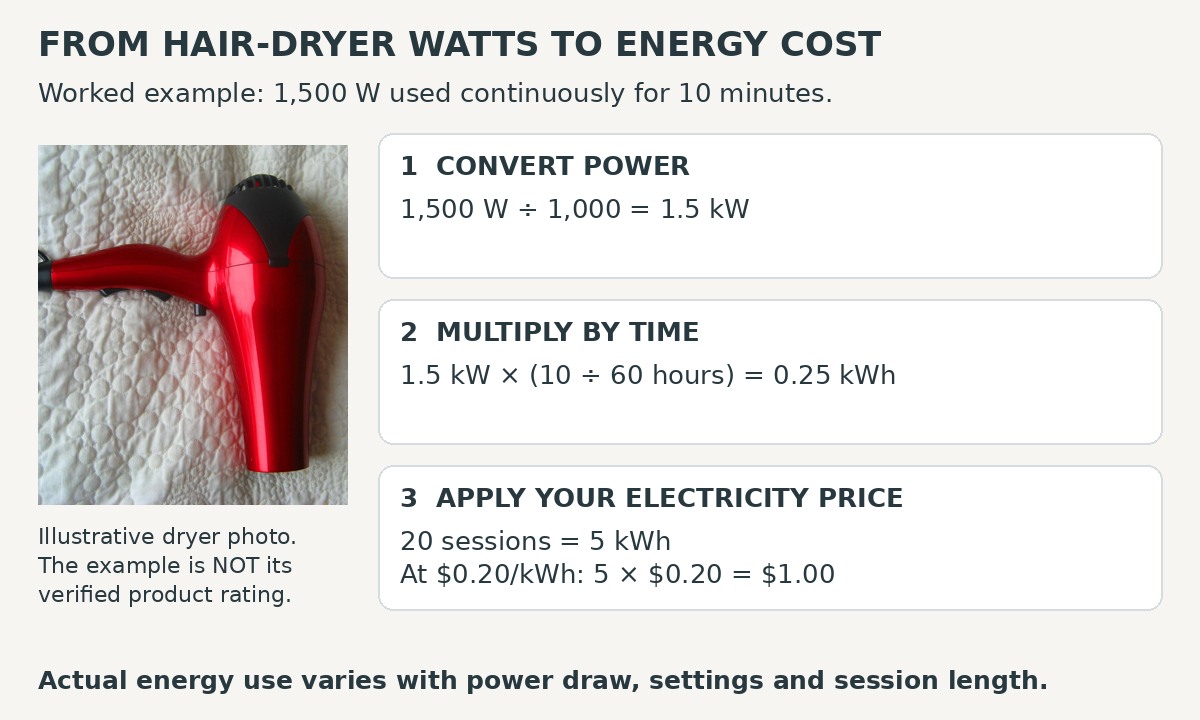
Energy calculation and annotations: Lather and Care. Photo: Hairdryer by Michael David Pedersen, https://www.flickr.com/photos/46289172@N04/4367601593; https://creativecommons.org/licenses/by/2.0/. Photo cropped and combined with original annotations. Illustrative photograph; 1,500 W is a hypothetical example, not the pictured model’s verified rating.
A monthly estimate you can do yourself
Multiply one session’s kWh by the number of sessions in a month. For the hypothetical 1,500-watt, 10-minute example:
- One session: 0.25 kWh
- 20 sessions: 5 kWh
- At a $0.20/kWh supply rate: $1.00 before any separate bill charges
The number is only an estimate. If you commonly use a cooler setting, stop sooner, or have a model that does not draw its maximum rating throughout use, consumption may be lower. If you want a measured result, use an electricity monitor that is rated for the appliance’s load and follow both the monitor’s and dryer’s instructions.
Bottom line
Hair-dryer wattage varies by model, so check your own unit’s label or manual rather than relying on a generic number. To estimate energy, divide its stated watts by 1,000 and multiply by hours used; multiply that estimate by your local electricity rate for a rough cost. For buying and everyday drying, do not treat wattage as a performance score. The exact label, usable heat and speed controls, airflow, attachments, and safe technique matter more than chasing the largest number.